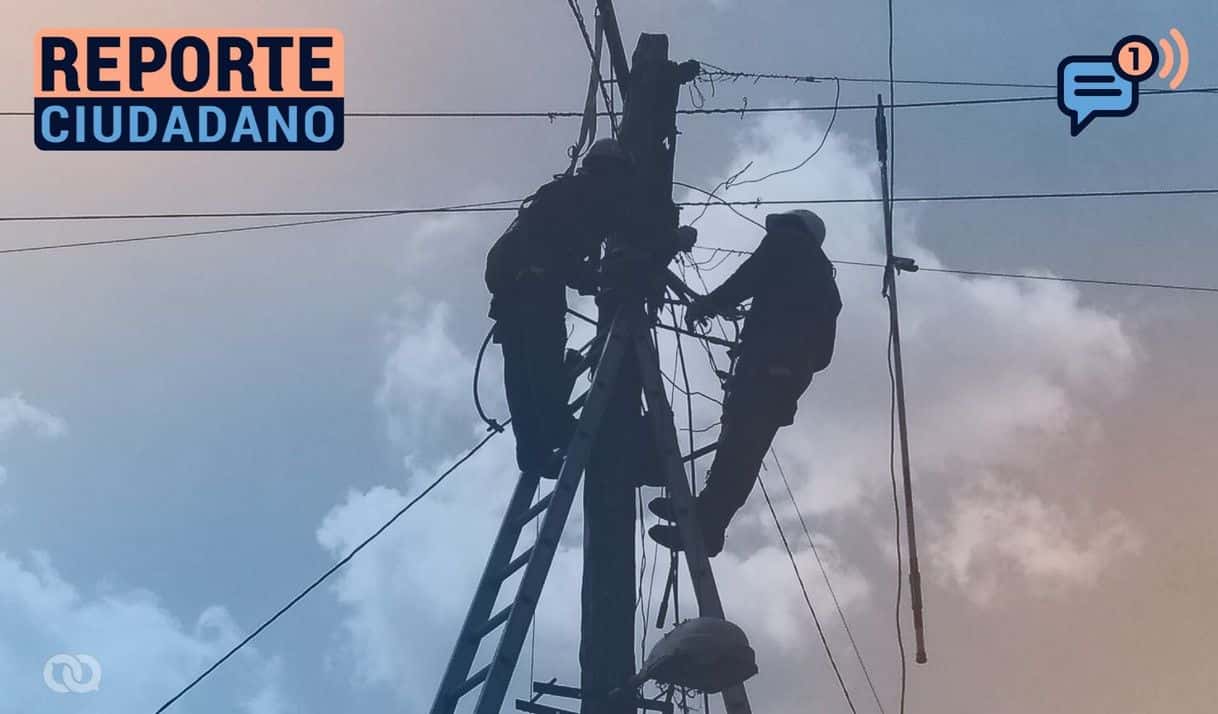
In Cuba, there is hardly any electricity. That is a fact. But the workers in this field also lack the means to perform their duties. A lineman told El Toque: “The conditions in which I work are awful and dangerous, lacking all safety and protective equipment.”
His message reached our newsroom in the midst of two incidents that shook Cubans. The first occurred on September 8, 2025, when official media acknowledged the death of 33-year-old turbine operator Carlos Rafael Lopez Ibarra, who had suffered an accident on August 31 during the start-up of Unit 5 of the “Antonio Maceo Grajales” Thermoelectric Plant. Until that moment, he had been hospitalized due to the severity of his burns.
Another accident occurred on September 12, 2025, around 2:00 p.m. Lineman Osmany Hernandez Madroza, 35, was repairing a fault at Pepe Prieto and San Manuel, in San Miguel del Padrón, Havana, when he came into contact with a broken conductor. He suffered burns on both arms, though he remained conscious. A video circulating on social media showed how neighbors rushed to help him after his fall.
A lineman is a specialized technician who builds, maintains, and repairs the infrastructure for power transmission and distribution. They work outdoors, installing poles, towers, and cables. They connect equipment (transformers, switches, etc.) and must be prepared to operate at heights and in all kinds of weather conditions. Is it possible to carry out these tasks in Cuba?
In the complaint received by El Toque, the lineman explained that the resources he needs are almost nonexistent in the country. “Uniforms are scarce; these are not a luxury, because our work requires them to be specially made for electrical tasks—they must resist current and fire,” he explained.
They also lack dielectric boots, a type of footwear designed to insulate against electricity. In their absence, they have had to use military boots or rubber boots normally used for farm work or rainy days, obviously unsuitable for electrical work.
“The harnesses and safety belts for working at heights are in terrible condition and are hardly available,” he said. “Sometimes there’s only one for the entire crew, when it should be personal equipment.”
There are no helmets, the ladders are old and broken, and dielectric gloves for working with high and low voltage are almost nonexistent.
Every day they perform “magic” to keep what little remains of the electrical distribution system running. “If a cable falls, we have to figure out where to take an unused one to make the repair. If a transformer burns out, we have to find one with less use to provide service to the population. Everything is like that because the warehouses are empty,” he admitted.
Due to the lack of materials and fuel, people living in remote areas go without electricity for up to ten days because there are no resources to reach them. The vehicles are also not in optimal condition, lacking tires and spare parts.
Given this situation, maintenance work on the power lines has stopped, which has led to more complex problems.
Among the biggest daily risks, he mentioned electrical contact and falls from heights due to lack of equipment. There have also been vehicle accidents caused by mechanical failures and the use of defective tools. In addition, linemen must face an “enraged population because of the blackouts.” “There have been many cases of attacks against us for reasons that are not our fault—it’s the Government’s responsibility, not ours,” he stressed.
According to data from the National Office of Statistics and Information (ONEI), workplace accidents in Cuba decreased in 2024. A total of 934 were recorded, 37.7% fewer than the previous year. But the number of deaths (52) remained the same for the third year, which means the fatality rate rose in terms of deaths per 1,000 injured.
This article was translated into English from the original in Spanish.




Comments
We moderate comments on this site. If you want to know more details, read our Privacy Policy
Your email address will not be published. Mandatory fields are marked with *
Todavía no hay comentarios.