
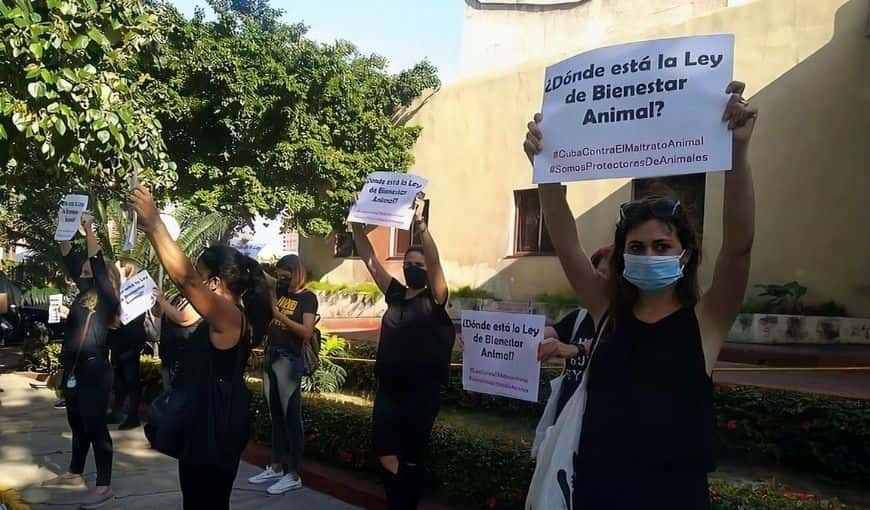
Over twenty animal rights activists met with high-ranking Ministry of Agriculture (MINAG) officials, after protesting outside this institution in black clothes and carrying posters that read: “Where is the Animal Protection Act?”, referring to the delayed law.
Beatriz Batista, one of the most prominent voices within this movement, described the exchange as a “productive dialogue”, and the first agreement was that the Animal Protection Act would be published this month, as the ministry had previously announced.
“We spoke about Aniplant, Zoonosis [dog catcher/pound] zoophilia, the abuse that we see towards animals every day in our society. We also spoke about the promised decree-law and for a “solution” to be found to all of these points. They even said that these independent projects and associations [like Aniplant] would be supported,” Legna Beatriz Otero posted on her Facebook page.
“We left encouraged and hopeful,” activist Ely Justiniani said during a special elTOQUE broadcast, in which she shared details about the dialogue.
“I was very afraid when I went there,” Keila Torres confessed on Facebook. “Seeing how dozens of people came out of a huge building, on the defensive, seeing our trivial bodies holding a poster, people taking photos of us from windows and shouting out slogans that had nothing to do with our presence there, it all made me weak at the knees.
“The invitation to come inside calmed me down, but so many people guarding the entrance and accompanying 20 people inside was intimidating. The dialogue? Broad-ranging, polite, firm, insistent, disorganized at times, with anecdotes, proposals for solutions… just like all of us there were.”
Torres talks about the tense moments leading up to the meeting. Independent journalist Hector Luis Valdes was arrested for several hours and there were reports of at least another two people in the same situation. One way things could have played out was the Government repressing the protest. Like what happened outside the Ministry of Culture in late January, when a group of artists and journalists had gathered together outside the institution where a dialogue was supposed to take place, and were instead arrested.
Vice Agriculture minister Ydael Perez, director of Animal Health, Yobani Gutierrez; the Ministry’s legal director, Orlando Diaz and the head of the Communications Department, Luis Montero, were some of the government representatives that received members from different groups who demanded information about the Act. “A higher tier law that provides animal wellbeing and collects and contemplates all of the concerns and requirements of people who love animals in Cuba,” a statement about the meeting published on the governmental body’s official website read.
On its Facebook page, MINAG referred to the meeting as a “constructive dialogue”. A news report on National TV spoke about a climate of respect between both parties. The report said the subjects discussed would be gathered together in the law. There was also talk about how to include animal protection in primary school education and in public campaigns in the mass media.
In a summary of the dialogue that took place in a “formal and respectful way”, Granma newspaper mentioned the penalization of animal abuse in all its forms and dimensions; regulations for work in veterinary clinics and practices; the revision and clarification of the concept of pets; and regulations that should regulate veterinary medicine in the private sector.
The Council of State passed three decree-laws on February 16th, none of which were the Animal Protection Act, which the government had announced would be passed this month, after being rescheduled in November 2020. Less than ten days before the end of February, in the face of uncertainty around a new delay to the Act, this group of activists decided to demand greater transparency about its content and a concrete date for its publication.
“We want a date for when the Animal Protection Act will be passed,” the advocates declared this morning. They managed to do just this through peaceful protest and being open to a dialogue with the government.


Comments
We moderate comments on this site. If you want to know more details, read our Privacy Policy
Your email address will not be published. Mandatory fields are marked with *
Todavía no hay comentarios.