
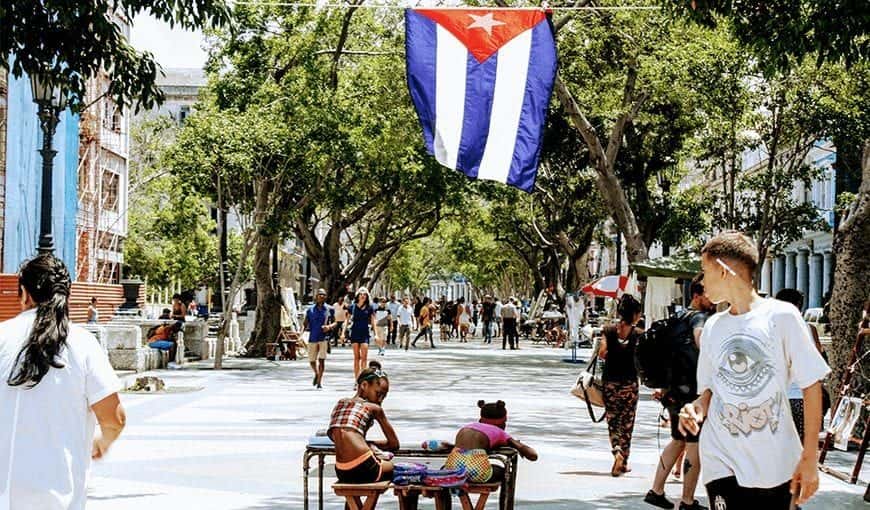
HAVANA TIMES – “What’s on your head?…” women are asked when they decide to leave their natural afro hair the way it is. “Once you go black, you never go back…”, people say among friends. “It had to be a black person,” one person says to another as they are pushed in a bus aisle and the other person doesn’t apologize. All of these everyday expressions, some of which are more subtle than others, but they can all be heard in any context here in Cuba.
While these are behaviors and comments that some people might deem “low intensity”, they are also the result of the population’s instilled racist preconceptions.
Racism doesn’t have to be overt or radically expressed as the persecution, slavery and extermination of a race, as these extreme situations are just the tip of the iceberg. It’s what we can’t see that is the most worrying because it isn’t aggressive, it forms a part of our everyday lives.
When I try to visualize this matter within my lifetime in order to make sense of it, I remember my years at the Vladimir I. Lenin vocational school. I remember being surrounded by white kids. The same thing happens when I think about my university years.
Now, I wonder: is it just a coincidence that there are so few black people in university classrooms and high-achieving pre-university centers, when we live in a country with such great racial diversity?
Cuba is a country of living together, and the integration and mixing of different cultures which emerged throughout our history. Black and Iberian (mostly Spanish) immigrants, indigenous people and the Chinese, all joined the “seasoning” that makes up “Cubanness” today. Cuban intellectual Fernando Ortiz put it wisely when he said: “Cuba is a stew (…) A mix of cuisines, a mix of races, a mix of cultures. A thick stew of civilization that bubbles on the Caribbean stove.”
In a country of 11.2 million inhabitants (reported in 2012 by Cuba’s state-led Office of Statistics (ONEI)), this was the racial breakdown of the population: 64.1% white, 9.3% black and 26.6% mixed race.
Even though the above figures indicates that the population is predominantly white, experts consider these results to be quite unreliable, given the fact that this was how the population identified themselves, who might not recognize themselves as Afro-descendants, even if they are.
Meanwhile, a genetic study carried out by the National Center of Medical Genetics in 2018 concluded that all Cubans are mixed-race, regardless of the color of their skin. The study confirms that civilian origins are structured in the following way: 2% Asian (China), 8% indigenous (Meso-American and South American people), 20% African (mainly from Benin, Nigeria, Cameroon, Gabon and Angola) and 70% are European (predominantly from Spain and some parts of Italy).
However, these figures aren’t enough because they don’t tell us anything about what they mean in today’s national context. Nor do they tell us about the connotations that are hidden and what they represent. For example: what is the relationship between different skin colors and social inequality today? Absolute silence.
One of the biggest challenges is the fact that the problem isn’t being recognized in the first place. In the report Cuba presented at the Third Session of the Regional Conference on Population and Development in Latin America and the Caribbean, it claims that the term “Afro-descendant” is not in keeping with our reality.
As a result, the intellectual baggage that exists surrounding this issue, which has been used to defend the anti-racist struggle and to delegitimize self-recognition of groups who identify as such, has been completely ignored.
“If we all deny the existence of this issue and the social shortcomings that nourish it, we are not only compromising the future of those who have yet to be discriminated against, but of all Cuban society. As the racial issue continues to be one of the most complex, challenging and overlooked in our social reality today,” US researcher and political analyst, Esteban Morales, stated.
Cuba has made great progress in the fight against racism, and these should be kept in mind when considering its positive contribution to the problem. However, we can’t just assume it has been overcome because of this, which is what government officials try to prove.
Racism has been creating this “great unknown” because of how invisible the issue is. The abovementioned report confirms this.
In this same document, it states that Cuban legislation in force condemns and sanctions any form of racial discrimination against a person, group of people or institution. However, in reality, things are different. A lack of statistics is a latent problem that this report uses to dilute out-of-date data and to deny its existence, thereby sweeping away any trace of the existence of ethnic minorities.
Referring in some cases to “Cubans with non-white skin”, the report explicitly omits an ethnicity that has its own name. Plus, there is no analysis of social minorities because they are said not to exist.
Women and men, black and mixed race people… they are all thrown into the same broken bag, which has been poorly stitched and has patches that try to feign alleged equality.
There hasn’t been a solution to the outcome of out-dated results of a census that lacks a deeper analysis of the race issue and real data that can confirm it, yet. It’s not as easy as taking out a variable from a mathematical equation.
The equation needs to be changed, putting the problem under the microscope, so that we can see that our belly button is also flawed, that the alleged “traces of racial discrimination” that this report mentions, have greater dimensions than what we think.
This article was translated to English from the original in Spanish.



Comments
We moderate comments on this site. If you want to know more details, read our Privacy Policy
Your email address will not be published. Mandatory fields are marked with *
Todavía no hay comentarios.